Designing an AI Assistant That Enhances Conversion
Research narrowed an ambitious brief into a focused and prioritised design, by showing where the technology adds value and where it doesn't.
Designing an AI Assistant That Enhances Conversion
Research narrowed an ambitious brief into a focused and prioritised design, by showing where the technology adds value and where it doesn't.
Designing an AI Assistant That Enhances Conversion
Research narrowed an ambitious brief into a focused and prioritised design, by showing where the technology adds value and where it doesn't.
Background
When a large Australian retailer asked Nomat to design an AI Assistant for their online store, they had a working prototype and a deadline. What they didn't have was a clear picture of how customers would actually use it, where it would build trust, and where it would quietly erode it. The brief looked like a simple chatbot project. The real task was to design something customers would keep coming back to and actually buy from.
Background
When a large Australian retailer asked Nomat to design an AI Assistant for their online store, they had a working prototype and a deadline. What they didn't have was a clear picture of how customers would actually use it, where it would build trust, and where it would quietly erode it. The brief looked like a simple chatbot project. The real task was to design something customers would keep coming back to and actually buy from.
Background
When a large Australian retailer asked Nomat to design an AI Assistant for their online store, they had a working prototype and a deadline. What they didn't have was a clear picture of how customers would actually use it, where it would build trust, and where it would quietly erode it. The brief looked like a simple chatbot project. The real task was to design something customers would keep coming back to and actually buy from.
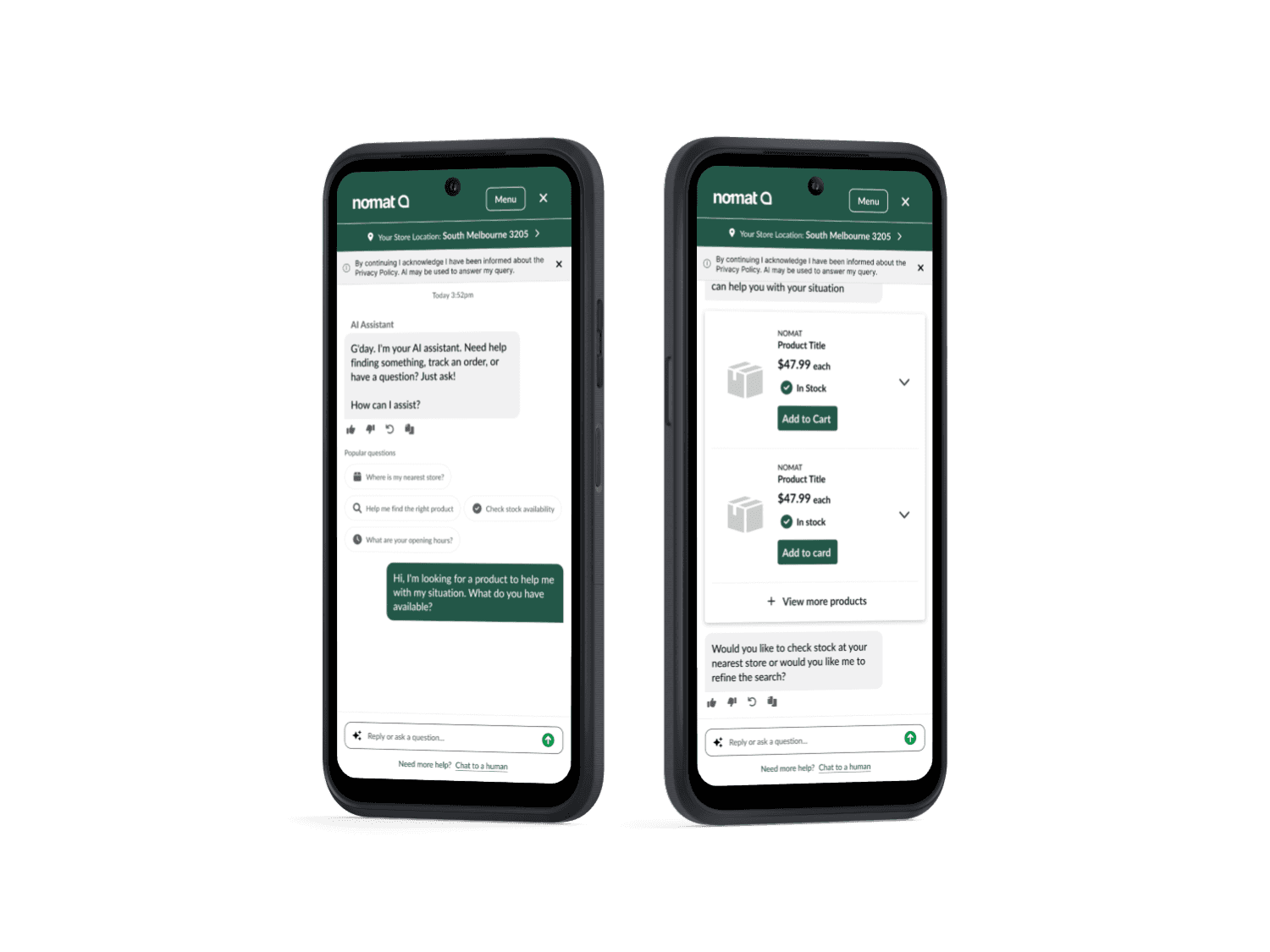
Proposed design for the AI Assistant website tool
What we did
Nomat's role was to design an AI Assistant customers would trust and use, one that earned its place in the buying journey rather than sitting alongside it. That meant building the prototype, testing it with real customers, and translating what we heard into design decisions the team could act on.
What we did
Nomat's role was to design an AI Assistant customers would trust and use, one that earned its place in the buying journey rather than sitting alongside it. That meant building the prototype, testing it with real customers, and translating what we heard into design decisions the team could act on.
What we did
Nomat's role was to design an AI Assistant customers would trust and use, one that earned its place in the buying journey rather than sitting alongside it. That meant building the prototype, testing it with real customers, and translating what we heard into design decisions the team could act on.
What we learned from customers
We tested the key journeys: searching for a product and checking it was the right match, checking stock, asking product questions, and being passed to a staff member when the assistant couldn't help. The behavioural patterns were consistent and two insights stood out.
The first was intent. Participants treated the assistant as a faster path to the products they wanted, not a replacement for the regular search bar. If it didn't offer a different experience from search, it lost its reason to exist.
The second was context. Participants expected the assistant to already know what they were shopping for, and to reflect the profiles they had saved on the site.
What we learned from customers
We tested the key journeys: searching for a product and checking it was the right match, checking stock, asking product questions, and being passed to a staff member when the assistant couldn't help. The behavioural patterns were consistent and two insights stood out.
The first was intent. Participants treated the assistant as a faster path to the products they wanted, not a replacement for the regular search bar. If it didn't offer a different experience from search, it lost its reason to exist.
The second was context. Participants expected the assistant to already know what they were shopping for, and to reflect the profiles they had saved on the site.
What we learned from customers
We tested the key journeys: searching for a product and checking it was the right match, checking stock, asking product questions, and being passed to a staff member when the assistant couldn't help. The behavioural patterns were consistent and two insights stood out.
The first was intent. Participants treated the assistant as a faster path to the products they wanted, not a replacement for the regular search bar. If it didn't offer a different experience from search, it lost its reason to exist.
The second was context. Participants expected the assistant to already know what they were shopping for, and to reflect the profiles they had saved on the site.
The build
Research told us what customers wanted. The harder question was where to compromise.
Buying was the clearest example of that tension. The research showed customers wanted the shortest path: add to cart straight from the assistant, no detours. But the business needed customers to see the compatibility notes before they bought, and the product page was the only place that guaranteed it. Both sides had a point. A product that works and a product that gets returned look the same in the cart. The work became finding a middle ground that worked for both sides: send the customer to the product page, but make the trip feel like part of the assistant's flow, not a detour out of it. That's where most of the work went.
What shipped was the version product, engineering, and operations could all stand behind. Not the shortest path, not the research ideal, but the one that holds up in the real world. The compromise was the difference between an assistant customers used once and one they came back to.
The build
Research told us what customers wanted. The harder question was where to compromise.
Buying was the clearest example of that tension. The research showed customers wanted the shortest path: add to cart straight from the assistant, no detours. But the business needed customers to see the compatibility notes before they bought, and the product page was the only place that guaranteed it. Both sides had a point. A product that works and a product that gets returned look the same in the cart. The work became finding a middle ground that worked for both sides: send the customer to the product page, but make the trip feel like part of the assistant's flow, not a detour out of it. That's where most of the work went.
What shipped was the version product, engineering, and operations could all stand behind. Not the shortest path, not the research ideal, but the one that holds up in the real world. The compromise was the difference between an assistant customers used once and one they came back to.
The build
Research told us what customers wanted. The harder question was where to compromise.
Buying was the clearest example of that tension. The research showed customers wanted the shortest path: add to cart straight from the assistant, no detours. But the business needed customers to see the compatibility notes before they bought, and the product page was the only place that guaranteed it. Both sides had a point. A product that works and a product that gets returned look the same in the cart. The work became finding a middle ground that worked for both sides: send the customer to the product page, but make the trip feel like part of the assistant's flow, not a detour out of it. That's where most of the work went.
What shipped was the version product, engineering, and operations could all stand behind. Not the shortest path, not the research ideal, but the one that holds up in the real world. The compromise was the difference between an assistant customers used once and one they came back to.
Services provided by Nomat:
Services provided by Nomat:
Services provided by Nomat:
Outcome
Through Nomat's involvement, the team understood which decisions to take off the customer's plate, which decisions belonged to the customer, and when the assistant should hand over to a human. The interface and user flows reflected a shared view of where the assistant added value, shaped by the conversations between research, design, engineering, and the business. That shared view is what shipped, and its now live, driving online conversions.
Outcome
Through Nomat's involvement, the team understood which decisions to take off the customer's plate, which decisions belonged to the customer, and when the assistant should hand over to a human. The interface and user flows reflected a shared view of where the assistant added value, shaped by the conversations between research, design, engineering, and the business. That shared view is what shipped, and its now live, driving online conversions.
Outcome
Through Nomat's involvement, the team understood which decisions to take off the customer's plate, which decisions belonged to the customer, and when the assistant should hand over to a human. The interface and user flows reflected a shared view of where the assistant added value, shaped by the conversations between research, design, engineering, and the business. That shared view is what shipped, and its now live, driving online conversions.
Interested to know more? Let’s Talk.
Interested to know more?
Let’s Talk.
Interested to know more? Let’s Talk.