Award-Winning Government Design: Designing Clarity for the Public
A comprehensive research and design program led to measurable improvements for the State Revenue Office’s Drupal website, creating a clearer and more intuitive experience for everyday Victorians. In 2026, the website received an Australian Web Award for Best Government Website.
Award-Winning Government Design: Designing Clarity for the Public
A comprehensive research and design program led to measurable improvements for the State Revenue Office’s Drupal website, creating a clearer and more intuitive experience for everyday Victorians. In 2026, the website received an Australian Web Award for Best Government Website.
Award-Winning Government Design: Designing Clarity for the Public
A comprehensive research and design program led to measurable improvements for the State Revenue Office’s Drupal website, creating a clearer and more intuitive experience for everyday Victorians. In 2026, the website received an Australian Web Award for Best Government Website.
Background
The State Revenue Office website had expanded over time, accumulating a broad range of tax guidance, forms, calculators and policy information as content grew to meet changing customer and legislative needs. This highlighted the need to simplify how information was organised and presented, while customer feedback identified opportunities to make it easier for users to self-serve online. Nomat was engaged to undertake a comprehensive program of user research and human-centred design to support the redevelopment of the site to ensure it continued to meet user needs and expectations. Working collaboratively with the SRO project team, we helped design the new website, including a revised information architecture and updated user interface.
Background
The State Revenue Office website had expanded over time, accumulating a broad range of tax guidance, forms, calculators and policy information as content grew to meet changing customer and legislative needs. This highlighted the need to simplify how information was organised and presented, while customer feedback identified opportunities to make it easier for users to self-serve online. Nomat was engaged to undertake a comprehensive program of user research and human-centred design to support the redevelopment of the site to ensure it continued to meet user needs and expectations. Working collaboratively with the SRO project team, we helped design the new website, including a revised information architecture and updated user interface.
Background
The State Revenue Office website had expanded over time, accumulating a broad range of tax guidance, forms, calculators and policy information as content grew to meet changing customer and legislative needs. This highlighted the need to simplify how information was organised and presented, while customer feedback identified opportunities to make it easier for users to self-serve online. Nomat was engaged to undertake a comprehensive program of user research and human-centred design to support the redevelopment of the site to ensure it continued to meet user needs and expectations. Working collaboratively with the SRO project team, we helped design the new website, including a revised information architecture and updated user interface.
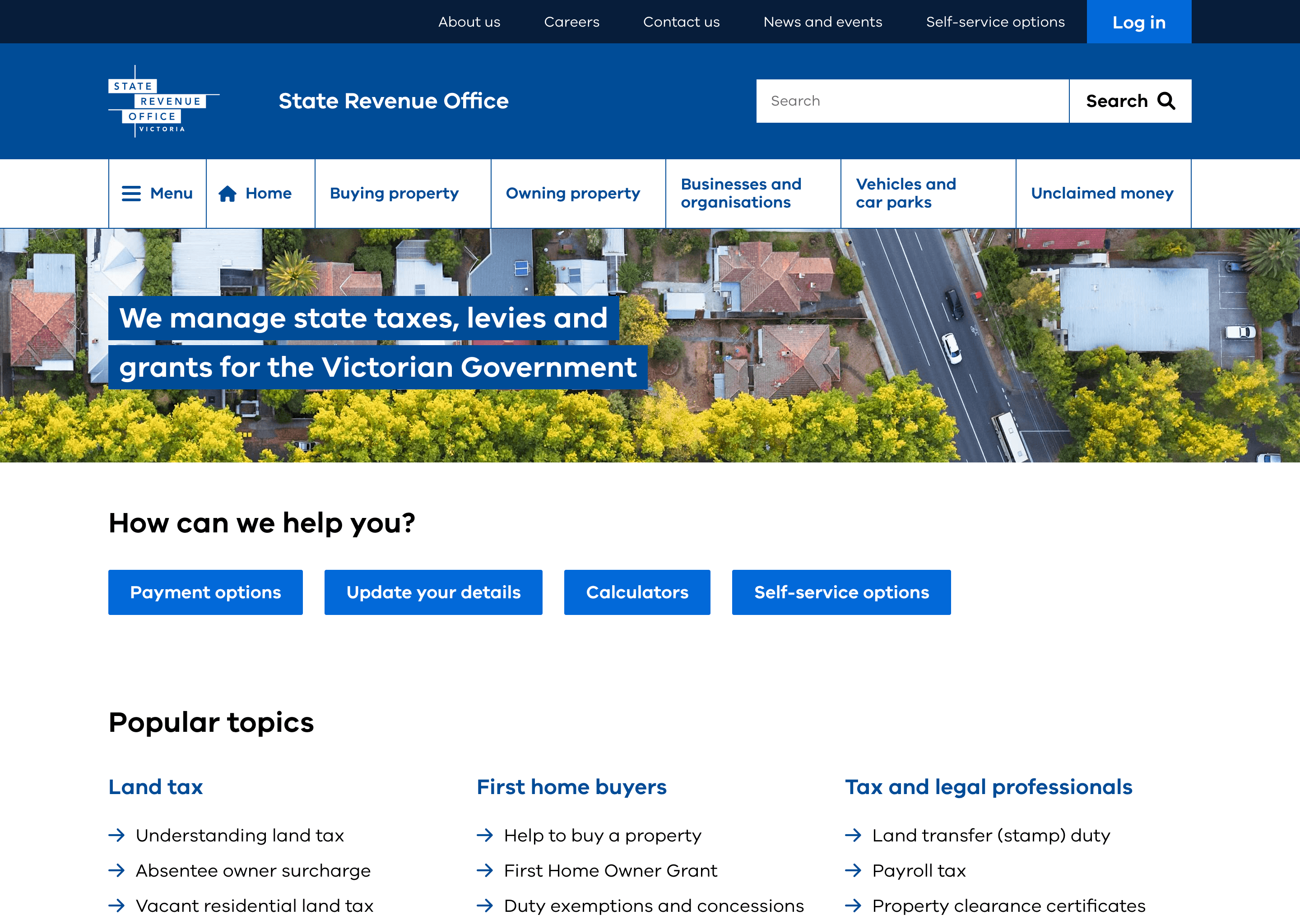
The updated State Revenue Office website (sro.vic.gov.au)
What we did
The website redevelopment was an opportunity to create something clearer and more effective for both customers and the organisation. Nomat was engaged to uncover insights that would lead to designing a better experience. Following the research phase, we brought our expertise in user experience, accessibility and UI to design the new site in close collaboration with the SRO project team.
What we did
The website redevelopment was an opportunity to create something clearer and more effective for both customers and the organisation. Nomat was engaged to uncover insights that would lead to designing a better experience. Following the research phase, we brought our expertise in user experience, accessibility and UI to design the new site in close collaboration with the SRO project team.
What we did
The website redevelopment was an opportunity to create something clearer and more effective for both customers and the organisation. Nomat was engaged to uncover insights that would lead to designing a better experience. Following the research phase, we brought our expertise in user experience, accessibility and UI to design the new site in close collaboration with the SRO project team.
Discovery research with users and internal stakeholders
Nomat undertook a comprehensive program of both online and in-person research to gather insights from website users and internal stakeholders, gathering vital perspectives for informing the design of the new site. The research included 11 remote stakeholder interviews and 6 stakeholder workshops with staff from across the organisation. These workshops brought together representatives from different business units, customer service teams and other key stakeholders, creating opportunities for collaborative discussion and idea generation.
To understand customer needs and behaviours, we conducted 34 moderated usability testing sessions and 2 focus groups with SRO customers. Co-design activities within these sessions allowed participants to suggest new features and ideas for improving the website experience. In total, Nomat engaged with 60 customers and 64 internal stakeholders, providing the organisation with confidence that the new website would better support the needs of its diverse user groups.
Discovery research with users and internal stakeholders
Nomat undertook a comprehensive program of both online and in-person research to gather insights from website users and internal stakeholders, gathering vital perspectives for informing the design of the new site. The research included 11 remote stakeholder interviews and 6 stakeholder workshops with staff from across the organisation. These workshops brought together representatives from different business units, customer service teams and other key stakeholders, creating opportunities for collaborative discussion and idea generation.
To understand customer needs and behaviours, we conducted 34 moderated usability testing sessions and 2 focus groups with SRO customers. Co-design activities within these sessions allowed participants to suggest new features and ideas for improving the website experience. In total, Nomat engaged with 60 customers and 64 internal stakeholders, providing the organisation with confidence that the new website would better support the needs of its diverse user groups.
Discovery research with users and internal stakeholders
Nomat undertook a comprehensive program of both online and in-person research to gather insights from website users and internal stakeholders, gathering vital perspectives for informing the design of the new site. The research included 11 remote stakeholder interviews and 6 stakeholder workshops with staff from across the organisation. These workshops brought together representatives from different business units, customer service teams and other key stakeholders, creating opportunities for collaborative discussion and idea generation.
To understand customer needs and behaviours, we conducted 34 moderated usability testing sessions and 2 focus groups with SRO customers. Co-design activities within these sessions allowed participants to suggest new features and ideas for improving the website experience. In total, Nomat engaged with 60 customers and 64 internal stakeholders, providing the organisation with confidence that the new website would better support the needs of its diverse user groups.
Expert review
Alongside the user research, Nomat was engaged to provide expert advice on how to improve the website's usability, accessibility and overall user experience. We conducted an expert review against established design heuristics and accessibility criteria, comparing it to other relevant websites in sectors such as taxation, local government services, banking and utilities. Nomat had previously delivered a comprehensive review of state and territory government websites across Australia and leveraged this to surface best practices and insights.
Expert review
Alongside the user research, Nomat was engaged to provide expert advice on how to improve the website's usability, accessibility and overall user experience. We conducted an expert review against established design heuristics and accessibility criteria, comparing it to other relevant websites in sectors such as taxation, local government services, banking and utilities. Nomat had previously delivered a comprehensive review of state and territory government websites across Australia and leveraged this to surface best practices and insights.
Expert review
Alongside the user research, Nomat was engaged to provide expert advice on how to improve the website's usability, accessibility and overall user experience. We conducted an expert review against established design heuristics and accessibility criteria, comparing it to other relevant websites in sectors such as taxation, local government services, banking and utilities. Nomat had previously delivered a comprehensive review of state and territory government websites across Australia and leveraged this to surface best practices and insights.
Personas and reporting
The research insights gathered were documented in a report, and user personas were developed to capture the key learnings in a format that was digestible and actionable. By visualising the personas, Nomat gave the project team a clear understanding of its diverse user base. These personas served as a tool to guide design decisions, ensuring that the website met the needs of its various users.
Personas and reporting
The research insights gathered were documented in a report, and user personas were developed to capture the key learnings in a format that was digestible and actionable. By visualising the personas, Nomat gave the project team a clear understanding of its diverse user base. These personas served as a tool to guide design decisions, ensuring that the website met the needs of its various users.
Personas and reporting
The research insights gathered were documented in a report, and user personas were developed to capture the key learnings in a format that was digestible and actionable. By visualising the personas, Nomat gave the project team a clear understanding of its diverse user base. These personas served as a tool to guide design decisions, ensuring that the website met the needs of its various users.
Website Experience & Content Direction
We applied the positioning to the website, focusing on clarity, structure, and usability.
Strengthened homepage messaging and narrative flow
Simplified product and capability descriptions
Reduced internal language and ambiguity
Supporting the sales process through behavioural design to encourage behavioural change as part of the sales process
Structured content for scanning and decision-making
Website Experience & Content Direction
We applied the positioning to the website, focusing on clarity, structure, and usability.
Strengthened homepage messaging and narrative flow
Simplified product and capability descriptions
Reduced internal language and ambiguity
Supporting the sales process through behavioural design to encourage behavioural change as part of the sales process
Structured content for scanning and decision-making
Website Experience & Content Direction
We applied the positioning to the website, focusing on clarity, structure, and usability.
Strengthened homepage messaging and narrative flow
Simplified product and capability descriptions
Reduced internal language and ambiguity
Supporting the sales process through behavioural design to encourage behavioural change as part of the sales process
Structured content for scanning and decision-making
Information architecture
The information architecture (IA) was identified as a key focus for improving the user experience. To inform the new site structure, we collaborated closely with the project team to run Card sorting and Tree testing activities. These provided a solid foundation of insights and evidence to guide the creation of the new IA structure.
Information architecture
The information architecture (IA) was identified as a key focus for improving the user experience. To inform the new site structure, we collaborated closely with the project team to run Card sorting and Tree testing activities. These provided a solid foundation of insights and evidence to guide the creation of the new IA structure.
Information architecture
The information architecture (IA) was identified as a key focus for improving the user experience. To inform the new site structure, we collaborated closely with the project team to run Card sorting and Tree testing activities. These provided a solid foundation of insights and evidence to guide the creation of the new IA structure.
Prototyping and usability testing new designs
A key aspect of the process was ensuring that the new designs would be an improvement on the current site. Usability testing a prototype of the new designs against the current site demonstrated significant improvement across the benchmarking metrics and allowed the team to understand where additional improvements could be made.
Prototyping and usability testing new designs
A key aspect of the process was ensuring that the new designs would be an improvement on the current site. Usability testing a prototype of the new designs against the current site demonstrated significant improvement across the benchmarking metrics and allowed the team to understand where additional improvements could be made.
Prototyping and usability testing new designs
A key aspect of the process was ensuring that the new designs would be an improvement on the current site. Usability testing a prototype of the new designs against the current site demonstrated significant improvement across the benchmarking metrics and allowed the team to understand where additional improvements could be made.
Designing the new site collaboratively
Following the completion of the research and prototyping phase, we continued to support the project team with the implementation. Working as an extension of their team, we worked collaboratively, providing UI design support and contributing UX and accessibility expertise.
Designing the new site collaboratively
Following the completion of the research and prototyping phase, we continued to support the project team with the implementation. Working as an extension of their team, we worked collaboratively, providing UI design support and contributing UX and accessibility expertise.
Designing the new site collaboratively
Following the completion of the research and prototyping phase, we continued to support the project team with the implementation. Working as an extension of their team, we worked collaboratively, providing UI design support and contributing UX and accessibility expertise.
Services provided by Nomat:
Stakeholder interviews
Insights playback
Reporting
Services provided by Nomat:
Stakeholder interviews
Insights playback
Reporting
Services provided by Nomat:
Stakeholder interviews
Insights playback
Reporting
Outcome
The State Revenue Office launched its redesigned Drupal website in 2025. A final round of usability testing on the live site confirmed a substantial improvement in user experience.
Participants consistently described the site as easier to navigate, clearer in structure and more intuitive overall. Many were able to locate information quickly, with the improved information architecture and visual design contributing to a stronger sense of clarity and confidence.
In 2026, the website was recognised with an Australian Web Award for Best Government Website, acknowledging the strength of the collaboration between SRO, Webplace and Nomat, and the impact of the evidence-led, human-centred design approach.
“Informed by extensive customer research, the site delivers a significantly improved user experience. Content is now easier to read and understand. Re‑organised information architecture and wayfinding helps people quickly find information relevant to them. The design feels clean and modern, with illustrative elements that make it feel more personable.”
Camryn Rothenbury, Digital Communications Manager, SRO
Outcome
The State Revenue Office launched its redesigned Drupal website in 2025. A final round of usability testing on the live site confirmed a substantial improvement in user experience.
Participants consistently described the site as easier to navigate, clearer in structure and more intuitive overall. Many were able to locate information quickly, with the improved information architecture and visual design contributing to a stronger sense of clarity and confidence.
In 2026, the website was recognised with an Australian Web Award for Best Government Website, acknowledging the strength of the collaboration between SRO, Webplace and Nomat, and the impact of the evidence-led, human-centred design approach.
“Informed by extensive customer research, the site delivers a significantly improved user experience. Content is now easier to read and understand. Re‑organised information architecture and wayfinding helps people quickly find information relevant to them. The design feels clean and modern, with illustrative elements that make it feel more personable.”
Camryn Rothenbury, Digital Communications Manager, SRO
Outcome
The State Revenue Office launched its redesigned Drupal website in 2025. A final round of usability testing on the live site confirmed a substantial improvement in user experience.
Participants consistently described the site as easier to navigate, clearer in structure and more intuitive overall. Many were able to locate information quickly, with the improved information architecture and visual design contributing to a stronger sense of clarity and confidence.
In 2026, the website was recognised with an Australian Web Award for Best Government Website, acknowledging the strength of the collaboration between SRO, Webplace and Nomat, and the impact of the evidence-led, human-centred design approach.
“Informed by extensive customer research, the site delivers a significantly improved user experience. Content is now easier to read and understand. Re‑organised information architecture and wayfinding helps people quickly find information relevant to them. The design feels clean and modern, with illustrative elements that make it feel more personable.”
Camryn Rothenbury, Digital Communications Manager, SRO
Interested to know more? Let’s Talk.
Interested to know more?
Let’s Talk.
Interested to know more? Let’s Talk.