
Chris Gray
16 Sept 2026
10 min read
Why thinking with your hands matters more in the age of AI
Nomat’s founder revisits why physical, hands-on methods like LEGO® Serious Play® still matter in an AI-driven world, arguing that the “mess” of making something is often where real thinking happens, and that teams risk losing it when AI hands them a polished answer too fast.
Almost ten years ago, I wrote about LEGO® Serious Play® and how we were using it at Nomat to explore complex problems through building.
At the time, one of the things that interested me most was the idea of the hand-mind connection: that creating something physically isn’t simply a way of representing an idea you’ve already had. The act of making can actually be part of how you arrive at the idea.
I’ve been thinking about that again recently, particularly as AI becomes a bigger part of how we work.
Thinking doesn’t always come before making
There can be an assumption that thinking and making happen sequentially. First, we work out what we think. Then we create the document, sketch, prototype, diagram or presentation that communicates it.
But a lot of creative and problem-solving work doesn’t happen like that.
Sometimes we understand something through the act of making it. You draw the customer journey and notice a gap. You move a sticky note and suddenly see a relationship between two things. You sketch an interface and realise the hierarchy doesn’t make sense.
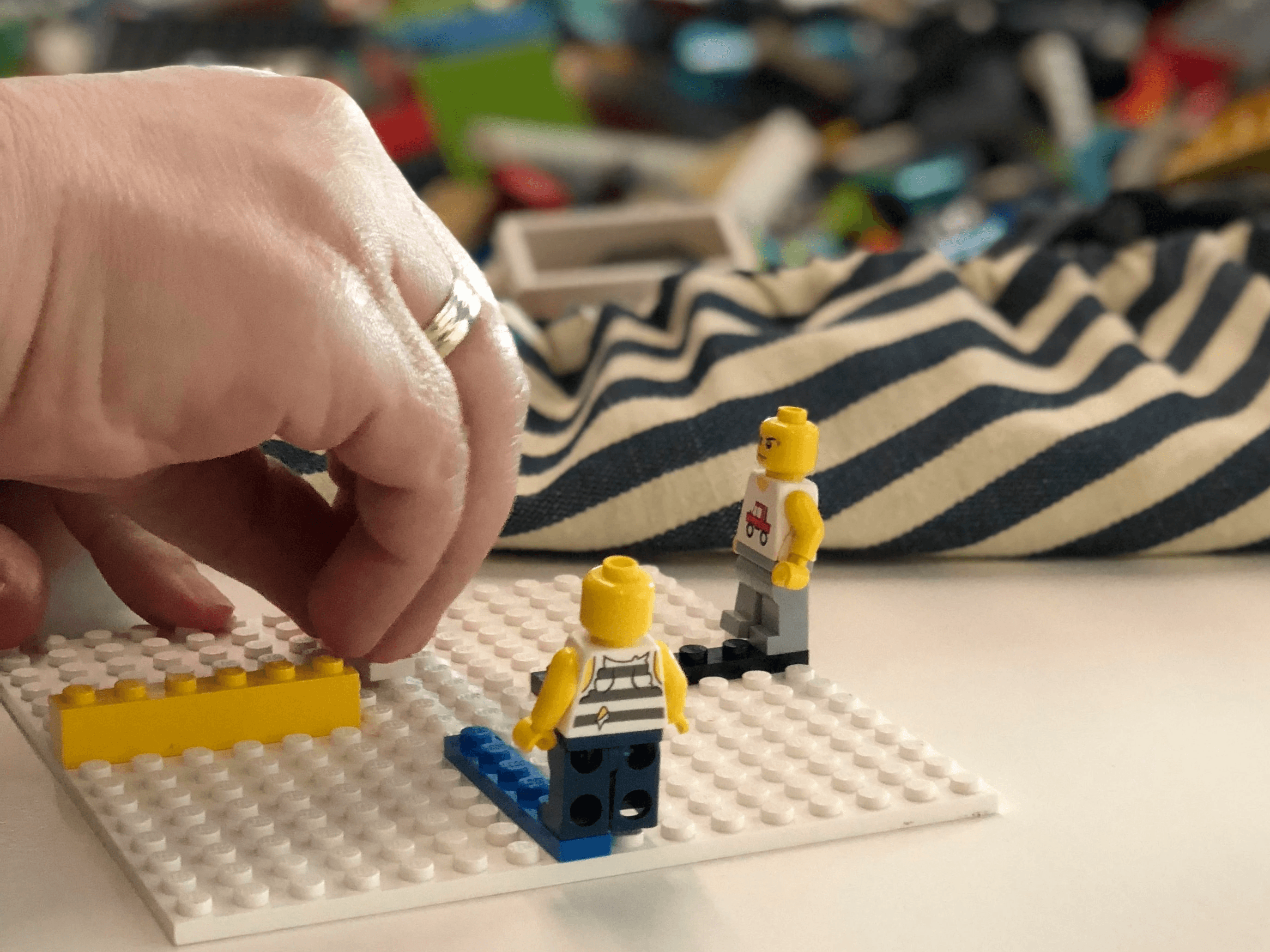
Or, in LEGO Serious Play, you start putting bricks together without necessarily knowing exactly what you’re going to build. The model takes shape, you respond to it, change it, add something, take something away and, somewhere in that process, your thinking develops too.
The doing is part of the thinking.
AI gives us the output, but skips the thinking
AI is extraordinarily good at creating things for us.
Give it a prompt and it can produce a first draft, synthesise research, generate concepts, create an image, suggest an information architecture or turn a few rough thoughts into something remarkably polished. Or at least something that appears polished.
There are obvious benefits to this. At Nomat, we’re increasingly looking at where AI can support us to remove effort and make different parts of our work faster and more effective.
But I think there is also an interesting tension we need to pay attention to.
When we remove some of the doing, do we also remove some of the thinking that used to happen while we were doing it?
If AI gives us a polished starting point in seconds, we don’t necessarily go through the messy process that would previously have taken us there.
But sometimes the mess was useful. It was where we noticed contradictions, tested assumptions, changed direction, made connections and worked out what we actually thought.
This isn’t an argument against AI. It’s an argument for being more conscious about where human thinking happens in an AI-enabled process.
Why building by hand still matters
This is one of the reasons I’ve found myself returning to LEGO Serious Play.
The methodology is grounded in constructionism: the idea that people develop knowledge through actively constructing things.
In a LEGO Serious Play workshop, you can’t simply ask AI to give you the answer and move on. You’re given a question and you have to build your response.
Your hands are occupied. You make choices. You experiment. You create metaphors. You change things. And then you have to explain what you’ve made.
Quite often, people don’t know exactly what they’re going to build when they start. That’s part of the point. The model helps them get there.
It also changes the dynamics of a group. Instead of the most confident or senior person articulating their answer first and everyone responding to it, everyone builds. Everyone has something tangible in front of them. Everyone explains their own model.
The object becomes something the group can explore together.

Where we use it: defining success before defining the product
This is exactly where we’ve found LSP most valuable in client work: not at the start of a project, but after discovery — once research has surfaced the real needs and constraints, and before a team jumps to defining the product.
At that point, it’s tempting to let AI (or a workshop facilitator) simply propose a solution. Instead, we use LSP with clients to build what success actually looks like for their customers — not a feature list, but a shared, tangible model of the outcome. Teams end up aligned on what “good” means before a single wireframe exists.
Slow down to go fast
One of the things I’ve been thinking about as we use AI more in our work is what happens to the thinking that used to happen while we were making something.
We’re naturally going to use AI to make things faster. We already are. But some of the work we’re speeding up was also where quite a lot of thinking used to happen.
There is value in having to wrestle with something for a while. To sketch it, build it, move things around, talk it through with someone else, realise it doesn’t quite work and have another go.
If you’re using AI to move faster, it’s worth asking where you’ve also removed the friction that used to produce your best thinking. Our challenge to clients — and ourselves — is to slow down deliberately at the moments that matter most: not to resist AI, but to make sure the thinking still happens somewhere.
Sometimes the fastest way to a good answer is still to pick up the bricks first.
Chris Gray
Managing Director & Principal Consultant
Chris is a leader in the Human Centred Design field with a 20+ year track record of improving customer interactions with some of Australia’s largest organisations. He is a strategic thinker who brings a calm and considered approach to tackling complex problems. An accomplished workshop facilitator, Chris excels at engaging with senior stakeholders and guiding projects to success. Chris has expertise in user research, service design and embedding Human Centred Design within organisations.
Latest posts

Chris Gray
16 Sept 2026
Why thinking with your hands matters more in the age of AI
Nomat’s founder revisits why physical, hands-on methods like LEGO® Serious Play® still matter in an AI-driven world, arguing that the “mess” of making something is often where real thinking happens, and that teams risk losing it when AI hands them a polis...


Bao Nguyen
17 Mar 2026
There's a person behind every great AI conversation
Conversation Designers are the secret behind great AI. Learn what they do, why they matter, and how Nomat can help.