
Bao Nguyen
17 Mar 2026
7 min read
There's a person behind every great AI conversation
Conversation Designers are the secret behind great AI. Learn what they do, why they matter, and how Nomat can help.
What Is a Conversation Designer?
Artificial intelligence is changing how Australians interact with the organisations they rely on every day. And as AI-powered products move from back-end experiments to front-line customer experiences, a new kind of design role has become essential: the Conversation Designer.
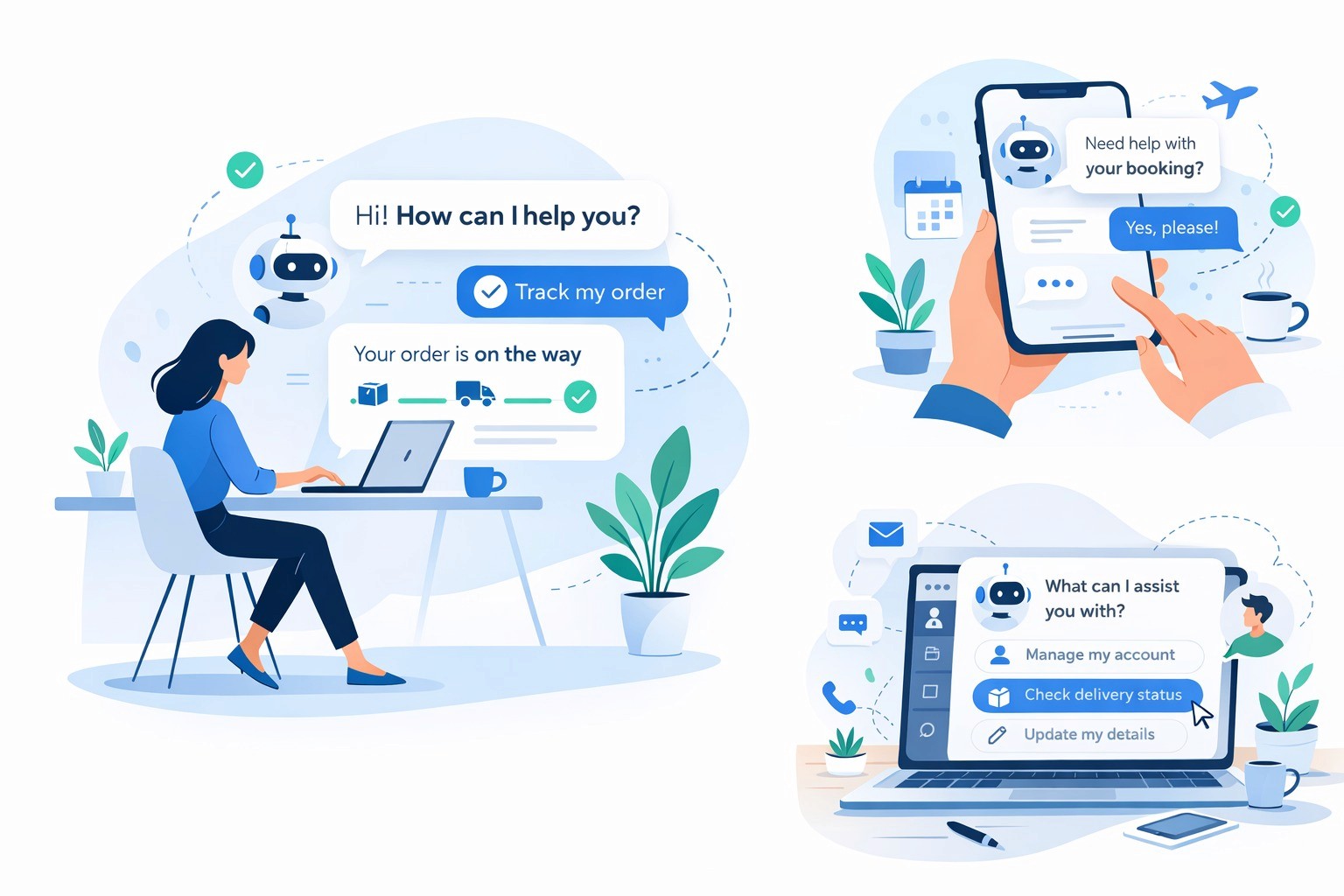
A Conversation Designer is the person responsible for shaping how an AI assistant communicates. According to the Conversation Design Institute, that means making sure AI assistants communicate in ways that work for both the business and the customer. In practice, it might involve writing dialogue flows, defining how a large language model (LLM) sounds, or deciding how the system should respond when a conversation goes off-script. The goal, at its heart, is to make technology feel genuinely human.
It is a role that sits at the intersection of UX design, linguistics, and AI engineering. As Voiceflow describes it, conversation design is about crafting interactions that genuinely connect with people, drawing on natural language processing, machine learning, and large language models to do so. Day-to-day, Conversation Designers map user needs, write dialogue, plan for edge cases, test experiences, and monitor how things perform once they are live. They work closely with product managers, developers, UX designers, and data scientists, sitting at the point where technical capability and human need meet.
Roles and Responsibilities
The work of a Conversation Designer spans both the creative and the analytical. A large part of it is designing and scripting conversation flows, mapping out the paths a dialogue can take and thinking carefully about what happens when a user says something unexpected. Alongside that, Conversation Designers run user research and usability testing to make sure interactions feel natural, and they are responsible for shaping the AI's personality, keeping tone and vocabulary consistent with the brand at every touchpoint.
The role also involves mapping user intent, building decision trees, and working with platforms like Voiceflow, Dialogflow, or Botpress to prototype, test, and refine experiences. After launch, the work continues, with Conversation Designers tracking how real users engage and adjusting flows accordingly.
While it shares some DNA with UX writing and content strategy, conversation design is its own distinct discipline. The interface is dialogue itself, not content on a page. Conversation Designers bring a working understanding of how AI systems function, which sets them apart from a traditional content or UX writer.
Why Australian Organisations Should Care
Australia is at a genuinely exciting moment with AI. Deloitte’s State of AI in the Enterprise 2026 finds that 61 per cent of Australian companies are already seeing efficiency gains, yet only 30 per cent are using AI to deeply transform how they work, compared to 34 per cent globally. There is real opportunity still on the table. And according to a 2025 report funded by OpenAI, in partnership with the Business Council of Australia and other industry bodies, AI could add up to A$142 billion annually to Australia’s GDP by 2030 under optimistic adoption scenarios. That is a significant prize, and customer-facing conversational AI is a meaningful part of how organisations will get there.
But the returns are not automatic. For organisations investing in AI-powered customer experiences, getting the conversational design wrong is not a minor detail. It can erode trust, frustrate users, and undermine the return on what is often a substantial investment.
The case for investing in conversation design is backed by strong numbers. A Smartsupp analysis of e-commerce website visits found that online stores using chatbots handle six times more customer conversations than those without, while resolving nearly 90 per cent of enquiries automatically. DemandSage reports that chatbots can improve conversion rates by up to 30 per cent. And Intercom’s Chatbot Trends Report links effective chatbot implementation to a 67 per cent increase in sales, with 26 per cent of all sales starting through a chatbot interaction. Results like these do not come from the technology alone. They come from experiences that have been thoughtfully designed.
Use Cases Across Australian Industries
Conversation Designers are already shaping customer experiences across a wide range of sectors in Australia. The global chatbot market reflects this momentum, with Grand View Research projecting it will reach USD$27.29 billion by 2030. Here is where it is happening locally.
Financial services: Virtual assistants are handling balance enquiries, transaction alerts, and financial guidance at scale. Bank of America’s Erica virtual assistant is a well-known benchmark. Australian banks and superannuation funds are following a similar path, using conversational AI to ease pressure on contact centres while lifting the experience for members and customers.
Insurance and utilities: AI chatbots are managing large volumes of customer conversations every year. Suncorp, for example, has deployed AI-enabled chatbots to handle a high volume of customer interactions, freeing frontline staff to focus on the enquiries that genuinely need a human.
Retail and e-commerce: Conversational AI is helping customers find products, receive personalised recommendations, and resolve post-purchase questions, bringing something closer to an in-store experience into digital channels.
Healthcare and government: Virtual assistants are reducing pressure on frontline teams by handling appointment bookings, eligibility enquiries, and service navigation. Australia’s National AI Plan, released in December 2025, supports broader AI adoption across public services, with improved service delivery in areas like health and aged care identified as a key area of opportunity.
Internal operations and HR: Organisations are using conversational AI for employee self-service, onboarding, and IT help desk support, giving HR teams the space to focus on work that genuinely requires a human touch.
Across every one of these contexts, the same truth holds: the technology is only as good as the experience built around it. Without skilled conversation design, even the most capable AI system can end up feeling frustrating, impersonal, and a long way from what it was built to deliver.
How Nomat Can Help
We have spent years helping enterprise-level organisations design complex, customer-facing digital experiences from the ground up. Across financial services, government, and utilities, we have worked through every stage of the design lifecycle, from early discovery and user research through to delivery, testing, and iteration. That experience puts us in a genuinely strong position as conversational AI becomes central to how organisations connect with their customers.
Conversation design is about much more than writing chatbot scripts. Done well, it requires a deep understanding of your users, your brand, your business context, and the technical platform you are building on. Our team brings together UX strategy, interaction design, content design, and AI expertise to support you at every stage, from dialogue mapping and prototyping through to launch and ongoing optimisation.
We also know what it means to work inside a large Australian organisation: legacy systems that need careful integration, user groups with varying levels of digital confidence, brand voices that need to stay consistent across every channel, and real pressure to show a return on investment. These are not abstract challenges for us. They are the kinds of problems we work through with our clients every day.
Whether you are launching your first AI assistant, improving a virtual agent that is not quite landing, or building conversational design capability as part of a broader transformation, we would love to help you create something that genuinely works for your customers and your business.
Ready to start a conversation about conversation design? Get in touch!
Bao Nguyen
Senior Designer and Researcher
Bao focuses on design solutions that find the right balance between the user’s needs and business’ goals, while prioritising visual aesthetics. He brings more than five years of experience in visual and user experience design. Bao is a passionate problem solver, creative thinker and enjoys working collaboratively with clients and stakeholders to get to the root of any problem.
Latest posts
Bao Nguyen
17 Mar 2026
There's a person behind every great AI conversation
Conversation Designers are the secret behind great AI. Learn what they do, why they matter, and how Nomat can help.


Marli Gray
21 Aug 2025
Celebrating Over a Decade of Partnership with Global Girl Project
Global Girl Project’s vision to empower girls through education, leadership and community engagement aligns strongly with Nomat’s own values of inclusion, human-centred design and long-term impact. By supporting GGP, we aim to amplify voices that are too...